
AGV automation plays a central role in modern intralogistics by enabling safe, reliable and continuous movement of materials inside warehouses, manufacturing plants, assembly lines and distribution environments. Automated Guided Vehicles automate internal transport tasks that would otherwise require manual labor, helping companies improve efficiency, reduce operational costs and ensure a consistent internal flow of goods.
This guide explains what AGV automation means, how it works, where it is used, and what companies should consider when implementing automated transport systems.
What is AGV automation?
AGV automation refers to the use of Automated Guided Vehicles to independently move materials inside a facility using predefined paths, navigation systems and centralized software control. AGVs handle repetitive transport tasks such as pallet movement, component delivery, and finished goods transfer without human intervention.
AGV automation combines three main elements:
- The vehicles themselves
- Navigation technologies that guide their movement
- Fleet management software that coordinates all vehicles
AGVs differ from traditional manually operated vehicles because they move autonomously and follow precise routes with high consistency.
How AGV automation works
AGV automation relies on a combination of sensors, navigation technologies, control software and connectivity to ensure safe movement throughout the facility.
Navigation and guidance technologies
AGVs can be guided by several methods depending on the facility and use case:
Laser navigation
AGVs use laser scanners to detect reflectors installed on walls or infrastructure. This allows precise route following and reliable long distance navigation.
Natural navigation
AGVs map their environment using sensors and follow this map without requiring reflectors or markers. This method provides flexibility for changing layouts.
Magnetic guidance
AGVs follow virtual lines. The positions are controlled by small in-floor magnets. This is a cost effective and reliable method supported by floor targets, but requires fixed paths.
Optical guidance
AGVs follow visual markers or painted lines on the floor using onboard cameras.
The navigation method affects flexibility, installation cost and the ability to change routes over time.
Fleet management and software
At the core of AGV automation is the fleet management system. This software coordinates all vehicles and ensures that each AGV receives tasks, avoids collisions and operates efficiently.
Key functions include:
- Task assignment and scheduling
- Traffic control and route planning
- Load balancing across the fleet
- Battery monitoring and automatic charging
- Integration with warehouse and production systems
- Real time monitoring and analytics
This software is essential for scaling from a single AGV to a fully automated fleet.
Integration with warehouse and production systems
AGVs often operate as part of a larger automated intralogistics environment. They are typically integrated with:
- Warehouse Management Systems (WMS)
- Warehouse Control Systems (WCS)
- Manufacturing Execution Systems (MES)
- ERP back end systems
Integration enables automatic task generation. For example, when a pallet arrives at goods receiving, the system triggers an AGV transport task without human input.
Connectivity and data
Modern AGVs rely on stable wireless communication and a continuous exchange of data with the control system. Sensors and IoT devices provide:
- Real time location tracking
- Battery health information
- Predictive maintenance data
- Obstacle detection accuracy
- Operational insights
This data is used to optimize routes, avoid congestion and increase throughput.
Key benefits of AGV automation
AGV automation offers significant advantages across many industries. Some of the most important benefits include:
Increased productivity and throughput
AGVs can operate continuously, without breaks or shift changes. This supports consistent material flow and higher output in both warehouses and manufacturing.
Reduced labor dependency
By automating repetitive transport tasks, companies can reduce manual workload and direct employees to value adding tasks such as quality control or assembly.
Improved safety
AGVs follow programmed routes and speed limits, detect obstacles and stop automatically when needed. This reduces workplace accidents compared to manual forklift use.
Space optimization
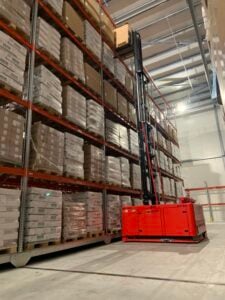
AGVs often require narrower aisles than manually operated vehicles. This allows better use of floor space and increased storage density.
Flexibility and scalability
Adding more AGVs to meet growing demand is significantly easier than expanding manual labor or buying new forklift fleets.
Data driven operations
AGV automation provides transparency into material flow, bottlenecks, vehicle utilization and task duration. This helps managers improve performance using data.
Typical applications and use cases
AGVs are widely used in industries where predictable, repetitive internal transport is required.
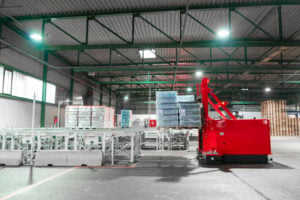
Warehousing and distribution
- Pallet transport
- Inbound and outbound handling
- Shuttle between storage zones
- Order consolidation and staging
AGVs reduce forklift traffic and support high volume operations.
Manufacturing and assembly lines
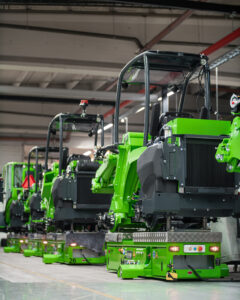
- Component delivery
- Work in progress transfer
- Finished goods movement
- Automated assembly line feeding
- Moving assembled objects at assembly lines
AGVs help maintain constant production flow with precise timing.
E commerce and fulfillment
AGVs support multi shift operations with fast cycle times and high throughput.
Automotive, food, pharma and heavy industry
AGVs are used in environments where safety, cleanliness or reliability are critical.
Implementation considerations
Introducing AGV automation requires careful planning to ensure successful deployment.
Site readiness
- Floor quality
- Clear pathways
- Loading and unloading points
- Charging infrastructure
- Safety zones and emergency stop systems
Choosing the right AGV type
- Unit load AGVs
- Pallet movers
- Forklift AGVs
- Heavy load piggyback AGVs
- Conveyor aboard AGVs
- Reel handling AGVs
- Coil handling AGVs
- Assembly AGVs
- Custom vehicles for unique applications
The correct choice depends on load type, weight and task profile among others.
Software and IT integration
AGVs must communicate with existing IT systems. Good integration ensures automatic task generation and smooth workflow.
Safety and compliance
AGVs must follow safety standards, including obstacle detection, emergency stopping and safe speed regulations.
ROI and cost considerations
Total cost includes:
- Hardware
- Software
- Installation
- Maintenance
- Training
- IT integration
ROI is driven by labor savings, uptime, consistency and throughput improvements.
Change management
Introducing automation may require workflow changes and staff training. Engaging operators early can improve adoption.
Technology trends and future directions
AGV automation continues to evolve rapidly, driven by new technologies.
Swarm coordination and multi robot collaboration
Large fleets increasingly operate collaboratively with advanced routing algorithms.
Infrastructure free navigation
AGVs with natural feature navigation enable flexible layouts and faster installation.
Sustainable energy and battery technologies
Fast charging, lithium iron phosphate batteries and energy efficient drive systems extend uptime.
Integration with industry 4.0 systems
AGVs are becoming part of fully connected production ecosystems that combine data, robotics and digital twins.
Frequently Asked Questions
How long does it take to install an AGV system?
Small systems can be deployed in weeks. Large fleets may take several months depending on integration needs.
How many AGVs does a facility need?
This depends on throughput, shift patterns, distances and cycle times. Simulation tools can be used for planning.
What is the lifespan of an AGV?
Typically 8 to 15 years, depending on usage and maintenance.
Do AGVs replace all forklifts?
Not always. Forklift AGVs handle many tasks but manual forklifts may still be needed for irregular or complex movements.
Key takeaways
AGV automation enables:
- Reliable material flow
- Higher productivity
- Improved safety
- Lower operating costs
- Scalable and flexible logistics
- Better use of space
- Data driven optimization
AGVs form a critical part of modern intralogistics and the shift toward automated and digitally connected facilities.
Are you looking for AGV’s for your industry?
Learn how other companies all around the world has transformed their material handling with AGV’s on the product page.